
The Party After

Cindy Lee played tennis so she could celebrate with her family. She has spent her life finding new people to celebrate with.

The first thing Cindy Lee ever won, she won for the party. She was eight, or thereabouts — she doesn't quite remember the age, only the place. Fairview Park, where she grew up, with its nine courts and its familiar faces. She would play, and if she won, there would be a celebration. Her family would gather. Her friends would come. Someone would bring food. The win mattered less than what came after it.
That is not a typical athlete's origin story. Most champions are built on something colder — a hunger, a grudge, a need to prove. Lee was built on the opposite. She played to make people happy. And if she played well enough, everyone would be happy together. It is a modest motivation, and a powerful one. It has carried her through a junior career, two years at a Melbourne tennis academy, a stint as a full-time Hong Kong athlete, a decade at TVB, and now into the strange second act of her life — where she is no longer an athlete, exactly, but something harder to name.
She is still throwing parties. The guest list has just gotten longer. The cost of it began to show around fourteen. "I didn't have time to dress up," she says. Not vanity — time. The bell rang and she was already gone: tennis shoes on, bag over her shoulder, out the door before her classmates had gathered their things. They went to the mall; she went to the courts. She does not say this with regret. She says it the way one might describe the weather in a particular year — a fact, nothing more.

She was already representing Hong Kong at junior level. The territory had given her a jersey and a schedule. What it could not give her was a standard. The training pool was thin; the competition was familiar; she had no way of knowing what she was actually capable of. There was an academy in Melbourne. The coach there had trained Philippoussis, had trained Sharapova. She asked her parents to let her go. She was fourteen — maybe fifteen; she doesn't remember the year, only the decision. They said yes. She stayed two years.
Hong Kong called her home before she had finished. The national team wanted her full-time. There was a scholarship — accommodation, travel, competition fees, all of it covered. She had imagined a different arrangement: study in Australia, train in Australia, let the two run in parallel. Instead she came back and became a professional athlete before she was old enough to vote.
Her father is a school principal. He could have insisted she stay and finish her education; he didn't. "He was very open," she says. "I thank him for supporting me." It is a small sentence, and she returns to it more than once.
The family was athletic before she was. Her mother, her aunt, her cousins — bowlers, all of them. Her father and sister — tennis. Sport was how the house spoke to itself. She was given the choice of what to play, and she chose the one that let her join in: doubles, the four of them, at Fairview Park. She wanted to be good enough to stand on that court as an equal.

What she wanted out of winning, though, was not what a coach would want her to want.
"My mentality was that I wanted my family and friends to be happy," she says. They came to every match. A loss would disappoint them. A win meant something else entirely — a celebration, a table, everyone together. She played for the gathering at the end of it. Not the trophy. The evening after.
It explains more about her than any result on her record does. She was not yet twenty when she entered Miss Hong Kong — an odd choice, on the face of it, for a girl who had spent her adolescence on tennis courts. She made the final five. She signed with TVB. The pageant put her in four-inch heels, and she has never entirely recovered from the experience.
"I'm definitely not a heels person," she says. "I'm a sneakers person." And then the sentence that explains the next twenty years of her life: "I don't think I belong on stage. I think I belong on a court."
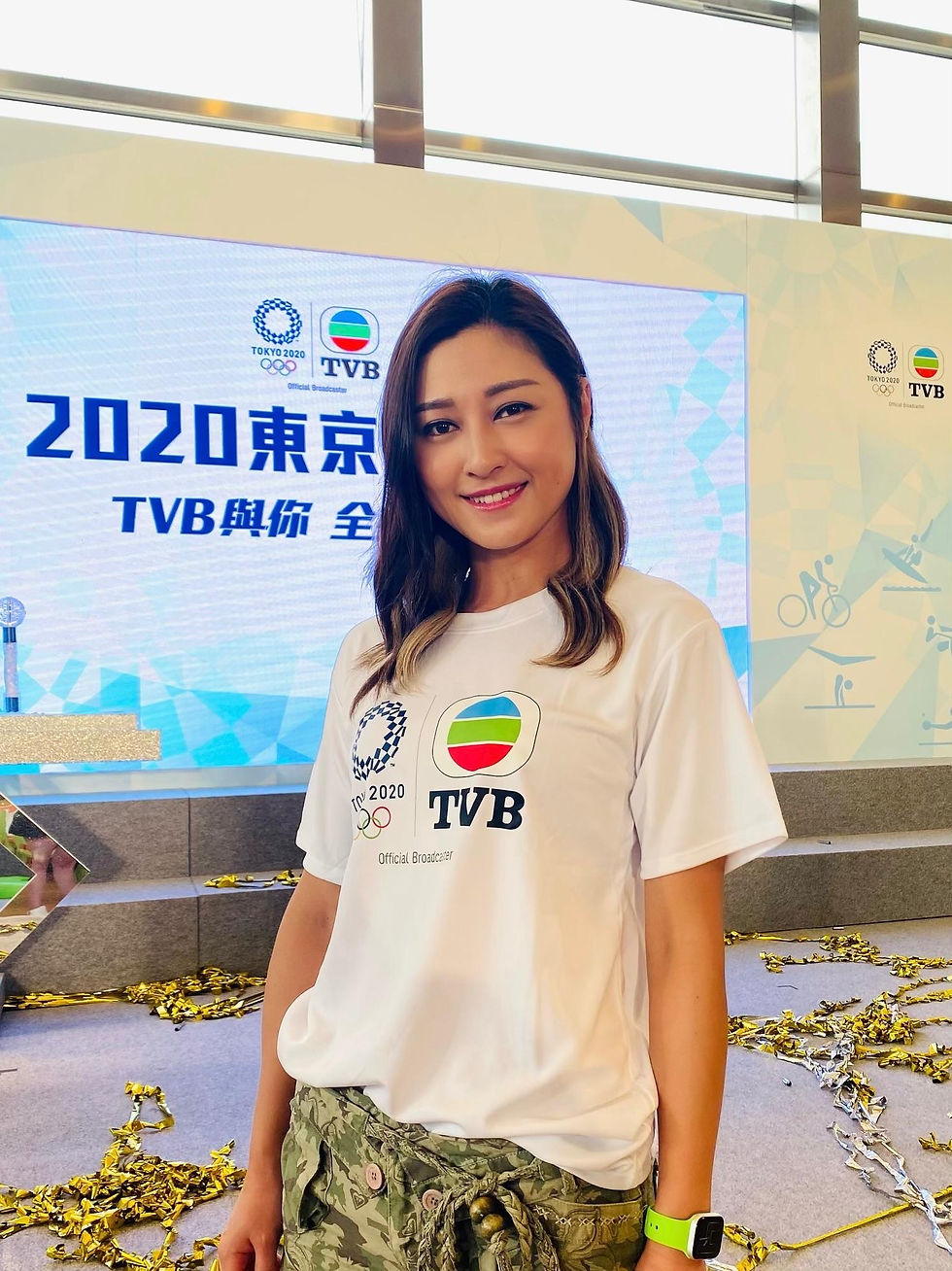
She says it lightly. She is not complaining. She spent more than a decade at TVB, and she is grateful for it — the hosting, the acting, the four Olympics she broadcast live. She learned the machinery of television from the inside. But she never became an actress, exactly. She became a version of herself that could be filmed. Which is a different thing.
She was in the studio. She had done this hundreds of times — the professional voice, the measured enthusiasm, the distance. And then a Hong Kong athlete did something no Hong Kong athlete had done. The distance collapsed. She cried on air. It is the only moment she describes without composure.
The pageant, the heels, the decade of work — she can discuss all of it with the equanimity of someone who has made peace with it. But Cheung Ka-long's gold, she cannot. Because in that moment, she was not a host. She was an athlete. And that identity has never really left her.
Which is why, when she tells another story — an earlier one, a shorter one, a less-known one — her tone changes. Not excitement. Longing.
Chik Kei-yee, a producer she had met through tennis, had cast her in a drama about the sport. Her sport. Her character would ride a scooter, racket on her back, skirt trailing in the wind. She went and got her motorbike licence for it. Passed first try.
The production never happened. Sponsorship problems. Since then, Hong Kong has not made a tennis drama. The scooter was never ridden. The skirt was never worn. She has stopped using the word. "I can't say I'm still an athlete," she says — as if the word were a jersey she handed back. But the life did not change when the label did. She runs A TEAM. She plays pickleball, promotes it, and there is now an elite team. She is a golf ambassador in Macau. She was an ambassador for skiing. Nine-tenths of her working life is sport — hosting it, organising it, playing it, selling it.
The only thing she surrendered was the noun. "I'm still learning," she says. "I want to be better. Be better — and everything else will come." It sounds like a coaching note, and perhaps it is one. She has been giving herself the same instruction for thirty years.
Her family still comes. That is the detail she returns to, more than any other. They sat in the stands when she was fourteen; they sit in the stands now. She says it makes her play better — that when they are watching, she wants to show them something.
Which is why the last question, the simplest one, produces an answer with no decoration at all.
"Sport is my life."
Four words. She does not elaborate. She does not need to. The courts are different now. The guests are different. The scooter was never ridden, and no Hong Kong drama about tennis has ever been made, and the word athlete is a jersey she handed back years ago.
But the party continues. It always does. She plays, they gather, everyone is happy together — and the evening after the match is still the part she stays for. The first thing she ever won, she won for the party. She has been finding reasons to throw one ever since.
This SCAA Opens Off Court series is brought to you by 御藥堂, Shun Hing Group, HEAD, Set Win Group, Coffee Academic, March & Rally, Linkers CPA Limited, POI Corporation Limited, Titoni, SmartShots, Watson's, Gym Aesthetics GA, 奇華餅家, Carlsberg, 甘棠燒鹅,儲存易迷你倉, Next Gen, TennisAsia, TNCL Total Nutrition Center Ltd, Little Apple Education Group Limited, Check Check Sin, ESG School HK, Wonder Mami, Eventist, Pones, 蒲昌酒庄. Wondermami.


Comments